


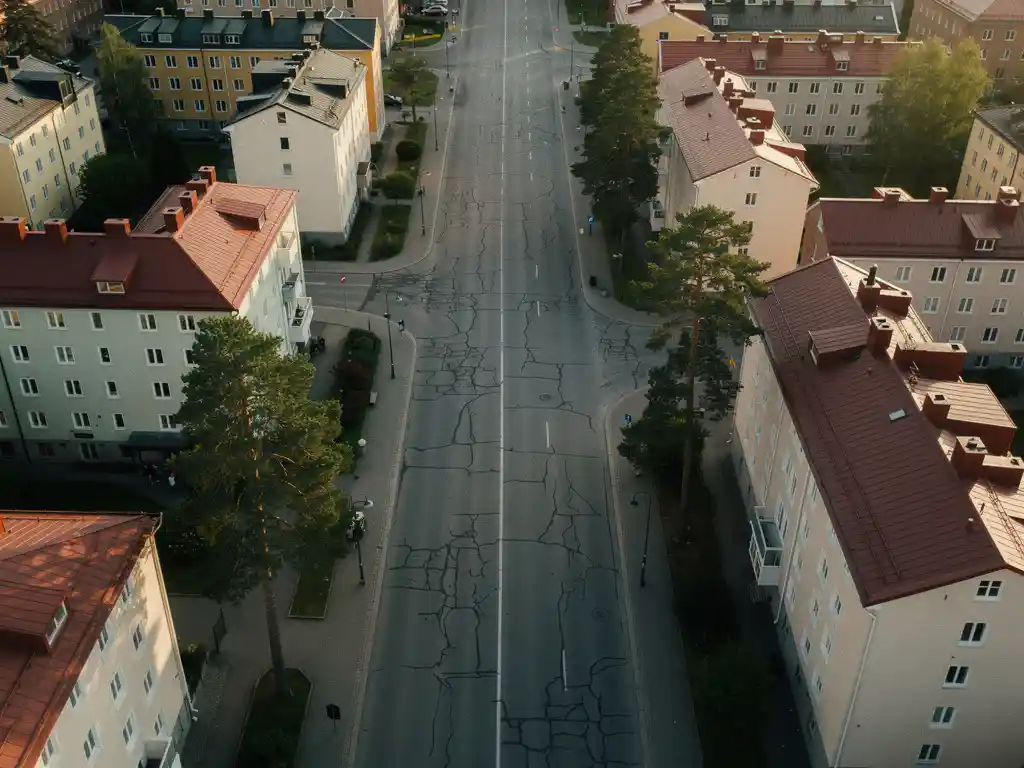
Urban roads deteriorate faster than rural highways primarily because of the combination of higher traffic density, more frequent utility excavations, urban heat effects, and complex drainage challenges. A rural highway might carry a few hundred vehicles per day, while a busy urban street handles thousands, including heavy delivery trucks and buses. This article unpacks the specific reasons behind accelerated urban road deterioration and what cities can do about it.
What makes urban roads structurally different from rural highways?
Urban roads are structurally more vulnerable than rural highways because they are built to serve a much wider range of functions within tighter physical constraints. While a rural highway is typically designed for continuous, high-speed traffic on a stable subbase, urban roads must accommodate stop-and-go traffic, heavy loads, underground utility networks, and frequent surface interventions, all within a densely built environment that limits how they can be constructed or repaired.
Rural highways generally benefit from deep, well-compacted subgrades and fewer interruptions to their structural layers. Urban roads, by contrast, are repeatedly cut open to access sewers, water mains, gas lines, and electrical conduits buried beneath the surface. Every excavation weakens the structural integrity of the pavement, even when the cut is properly patched. Over time, a city street accumulates dozens of these weak points, making it far more prone to cracking and surface collapse than an undisturbed rural road.
Urban roads also tend to have thinner asphalt layers relative to the loads they carry, partly because underground infrastructure limits how deep road engineers can work. This structural compromise means the pavement has less capacity to distribute weight and absorb stress before damage begins to show.
How does traffic volume and load affect urban road wear?
Traffic volume and vehicle load are among the biggest drivers of urban road deterioration. Road surfaces experience stress every time a vehicle passes over them, and that stress compounds rapidly with heavier vehicles. A single heavily loaded truck causes significantly more pavement damage than thousands of passenger cars, and urban roads see a constant mix of both, including delivery vans, buses, refuse trucks, and construction vehicles operating on tight, repetitive routes.
The stop-and-go nature of urban traffic makes this worse. When vehicles brake and accelerate repeatedly, they apply shear forces to the road surface that are far more damaging than the rolling load of a vehicle moving at a steady highway speed. Bus stops, traffic lights, and junctions are particularly vulnerable spots because the same stress is applied in the same location hundreds of times per day.
Urban freight patterns have also intensified in recent years. The growth of last-mile delivery has added more frequent, heavier vehicle movements on residential streets that were never designed to handle that kind of load. The result is accelerated surface cracking, rutting, and pothole formation in areas that once saw relatively light traffic.
Why do utility cuts and underground works damage urban roads?
Utility cuts are one of the leading causes of premature urban road surface damage. Every time a trench is dug to access or install underground services, the surrounding pavement and its supporting layers are disturbed. Even a well-executed repair rarely restores the original structural integrity, leaving a zone of weakness that tends to crack, sink, or separate over time, especially under repeated traffic loading.
The problem is not just the patch itself. Excavation disrupts the compaction of the subbase and subgrade layers beneath the road surface. Water can infiltrate through imperfect seals at the edges of the patch, accelerating freeze-thaw damage in colder climates and softening the base layers in wet conditions. Over months and years, these patches become the starting points for wider surface deterioration.
Urban environments have a high density of underground infrastructure, meaning a single street may be cut open multiple times over its lifespan by different utility operators. Each intervention adds to the cumulative structural damage. Some cities have introduced coordination requirements to reduce the number of separate excavations, but managing the long-term impact of utility works remains one of the most persistent challenges in urban road maintenance.
How does urban heat and the heat island effect accelerate road damage?
Urban areas are significantly warmer than surrounding rural regions, a phenomenon known as the urban heat island effect. This elevated temperature directly accelerates asphalt road deterioration. Asphalt softens in high heat, making it more susceptible to rutting under heavy traffic. When temperatures fluctuate sharply between day and night or between seasons, the repeated expansion and contraction of the road surface causes thermal cracking that gradually widens with each cycle.
Dark asphalt surfaces absorb more solar radiation than lighter rural road materials, which means urban road surfaces can reach temperatures well above the ambient air temperature on hot days. This thermal stress is compounded by the heat radiated from buildings, vehicles, and urban infrastructure surrounding the road. In cities with significant seasonal temperature variation, the combination of summer heat softening and winter freeze-thaw cycles creates a particularly aggressive deterioration cycle.
Climate patterns in 2026 are reinforcing this challenge. As average temperatures rise and extreme heat events become more frequent, cities are seeing asphalt roads reach damaging temperature thresholds more often and for longer periods. This makes road surface material selection and maintenance scheduling increasingly important factors in managing long-term road condition.
What role does water and drainage play in urban road deterioration?
Water is one of the most destructive forces acting on urban road surfaces, and poor drainage dramatically accelerates road damage. When water penetrates the road surface through cracks, joints, or utility cut edges, it weakens the base and subgrade layers beneath. Under traffic load, this saturated material loses its load-bearing capacity, leading to surface deformation, cracking, and pothole formation.
Urban environments create specific drainage challenges that rural roads rarely face. Impermeable surfaces such as buildings, pavements, and car parks concentrate runoff onto roads rather than allowing it to disperse into the ground. Combined with aging or undersized drainage infrastructure, this means urban roads are frequently exposed to standing water and repeated wet-dry cycles that degrade the pavement structure over time.
Freeze-thaw cycles are particularly damaging in cities with cold winters. Water that has infiltrated a crack expands when it freezes, forcing the crack wider. When the ice melts, the enlarged crack allows more water to enter, and the cycle repeats. Over a single winter season, a hairline crack can develop into a significant surface failure. Urban roads, with their higher density of existing cracks and utility cut edges, provide more entry points for water than a well-maintained rural highway.
How can cities slow down urban road deterioration with smarter maintenance?
Cities can significantly slow urban road deterioration by shifting from reactive repairs to proactive, data-driven maintenance. The traditional approach of waiting until a road is visibly damaged before acting is both costly and inefficient. By the time surface damage is obvious, the underlying structural deterioration is often already advanced. Proactive maintenance, based on regular condition monitoring and early intervention, extends road lifespan and reduces the total cost of upkeep.
Several practical strategies make a measurable difference:
- Regular condition surveys: Systematically documenting road surface conditions across the network allows maintenance teams to identify deterioration early, before minor cracks develop into major failures.
- Prioritized repair scheduling: Not all road damage requires immediate action. Condition data helps teams rank repairs by severity and traffic impact, directing resources where they will have the greatest effect.
- Coordinating utility works: Requiring utility operators to coordinate excavations reduces the number of separate cuts in the same road section and ensures patches meet quality standards.
- Surface treatments before failure: Preventive treatments such as crack sealing and surface dressing applied to roads in early deterioration are far cheaper than full resurfacing once damage has progressed.
- Improved drainage maintenance: Keeping drains and gullies clear reduces water infiltration and the freeze-thaw damage it causes.
Technology plays a growing role in making these strategies practical at scale. AI-powered road monitoring tools allow cities to survey large road networks quickly and consistently, automatically identifying surface damage such as cracks and potholes, tracking how conditions change over time, and generating the data needed to plan and justify maintenance budgets. This kind of systematic, evidence-based approach is what separates cities that manage to keep their roads in good condition from those that are constantly reacting to failures.
This is exactly where we at ScanwAi can help. Our platform combines a mobile data collection app with AI damage detection and an interactive map dashboard, giving cities, municipalities, and contractors a clear, up-to-date picture of road conditions across their entire network. By analyzing both current and historical data, our system supports predictive maintenance planning that can reduce maintenance costs by up to 40%, helping you get ahead of deterioration rather than chasing it. If you are responsible for urban road infrastructure and want to move toward smarter, more sustainable maintenance, we would be glad to show you how it works in practice.